
Wood Stove Buying Guide: Size, Type, and Real Costs
How to choose a wood stove: size it to your heat load, pick catalytic, non-catalytic or hybrid, read the EPA label, and budget the real installed cost in 2026.
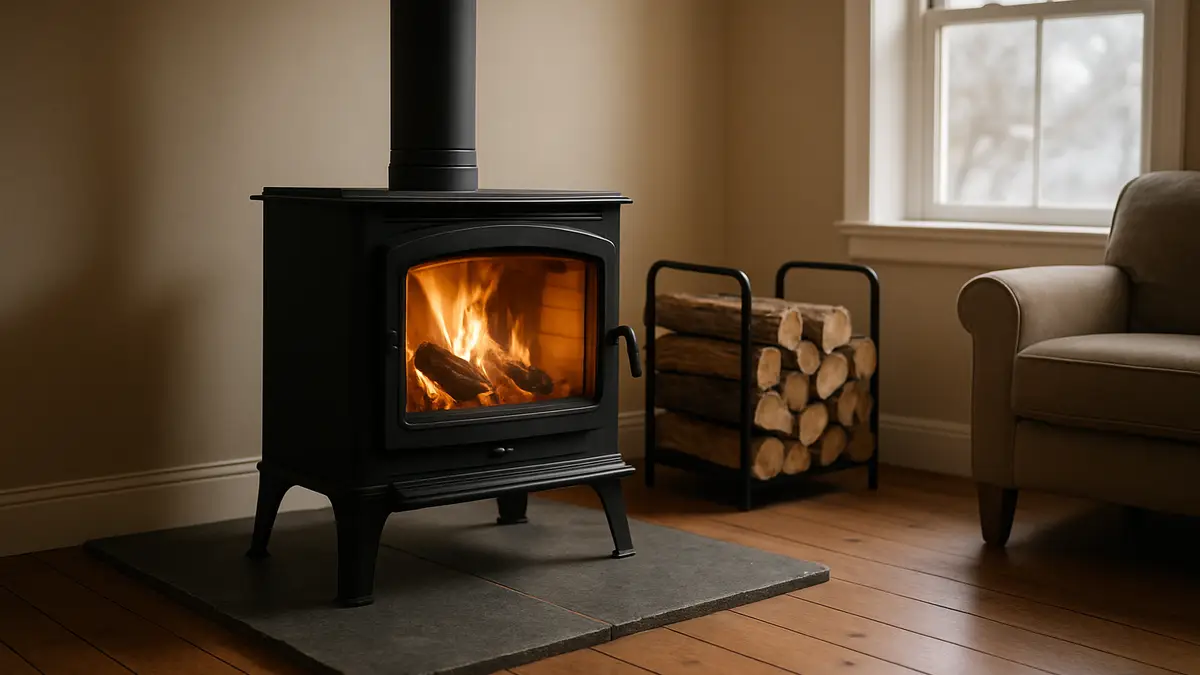
A wood stove is a closed, freestanding firebox that burns cordwood to heat a room or a whole house, venting through a chimney. Buying one well comes down to three decisions in order: how much heat you need, which combustion type fits how you burn, and what the full installation will cost. This guide walks through each with numbers you can check. It does not pick models; for named picks with EPA test data, see the best wood stoves of 2026.
What size wood stove do I need?
Size a wood stove to your home’s design heat load, the BTUs per hour the house loses on a typical coldest night, not to the square footage on the box. A reasonable target is a stove whose EPA-tested maximum output is at least your design load and no more than about 1.5 times it.
As an example, a 2,000 sq ft house with average insulation, 8 ft ceilings and a Chicago-like winter (0 F design temperature) loses about 48,000 BTU/hr at 68 F indoors. The same house built tight (2010 or later) needs about 29% less, and the original house moved to an Atlanta-like climate needs about 31,000 BTU/hr. Climate and insulation swing the answer more than floor area does.
The wood stove size and firewood calculator runs this math for your area, insulation level and climate zone, and also estimates how many cords a winter will take.
Why do “heats up to X sq ft” claims mislead buyers?
Square-footage and maximum-BTU claims on brochures come from best-case assumptions, while the EPA test reports the heat output a stove actually delivered in a controlled burn. The two can differ by close to half.
| Stove | Maker’s claim | EPA-tested output range (BTU/hr) |
|---|---|---|
| Jøtul F 500 V3 Oslo | 70,000 BTU max, up to 2,300 sq ft | 14,001-38,804 |
| WoodPro 300 | 61,700 BTU/hr, up to 3,000 sq ft | 13,239-36,757 |
| US Stove US2000 | heats 2,000 sq ft | 11,565-34,130 |
| Woodstock Progress Hybrid 209b | up to 2,200 sq ft | 15,257-35,222 |
Claims checked on maker pages in October 2026; output ranges from the EPA Certified Wood Heater Database pulled on October 6, 2026. Compare your design load to the EPA range, and treat the square-footage figure as marketing.
Why is an oversized wood stove a problem?
An oversized wood stove forces you to choke the air supply to keep the room bearable, and a starved fire smolders. Smoldering wastes fuel, blackens the glass and sends unburned smoke up the flue, where it condenses as creosote, the tar that fuels chimney fires.
A stove sized to the load can run at the moderate burn rates it was designed and tested for. If your calculated load falls between two models, the smaller one usually serves better in a well-insulated house, while a drafty house in a cold zone justifies the larger. Rooms under about 1,000 sq ft, cabins and workshops have their own trade-offs, covered in the small wood stoves guide.
Catalytic, non-catalytic or hybrid: which type should you buy?
A catalytic wood stove routes smoke through a coated combustor that ignites it at lower temperatures, a non-catalytic stove burns the smoke with preheated secondary air from tubes above the fire, and a hybrid uses both. In the EPA database, catalytic and hybrid designs test measurably cleaner and more efficient.
| Type (EPA subtype) | Rows in database | Median efficiency (HHV) | Median emissions | Efficiency range |
|---|---|---|---|---|
| Non-catalytic | 92 | 71% | 1.7 g/hr | 59-80% |
| Catalytic | 34 | 78% | 1.1 g/hr | 70-83% |
| Hybrid | 24 | 78.5% | 0.87 g/hr | 76-81% |
Source: our pull of all 150 currently certified wood stove rows on October 6, 2026. One row can cover several model names that share a firebox. The difference matters at the woodpile: at the same heat delivered, a 78% stove burns about 9% less wood than a 71% stove.
Is a catalytic wood stove worth the extra cost?
A catalytic wood stove is worth it if you want long, low, overnight burns and will look after the combustor. Catalytic stoves hold a fire at low output for far longer per load; Blaze King lists up to 32 hours on low for its Princess 32 and up to 40 hours for the King 40.
The trade-offs are maintenance and a bypass damper you must operate correctly. Combustors wear out and need replacement: Woodstock Soapstone sells replacement combustors for its stoves at $320 to $325 (October 2026). If you burn hot fires and reload every few hours, a non-catalytic stove gives similar daytime heat with fewer parts to replace.
Steel, cast iron or soapstone: does the body material matter?
The body material changes how fast a stove heats up and how long it radiates after the fire dies down, not how much heat the wood contains. Steel stoves warm up fastest and are usually the least expensive. Cast iron stoves are bolted from castings, look traditional and take longer to warm. Soapstone stoves are the heaviest, slowest to warm and keep radiating gentle heat for hours.
Weight shows the difference: the cast iron Jøtul F 500 V3 weighs 445 lb, while the soapstone Woodstock Progress Hybrid weighs 700 lb (maker specs, October 2026). Heavy stoves need a floor that can carry them, so ask your installer before you order.
What does EPA certified mean on a wood stove?
An EPA-certified wood stove has passed the federal emission limit for new residential wood heaters. Since May 15, 2020 (Step 2 of the New Source Performance Standards), every new wood and pellet stove sold in the US must emit no more than 2.0 grams of particulate per hour in the crib wood test, or 2.5 g/hr if tested with cordwood.
Certified stoves carry a permanent metal label on the back. The EPA Certified Wood Heater Database lists each certified model line with its tested emissions, overall efficiency (HHV), heat output range and firebox volume. The EPA’s Burn Wise consumer site stopped updating on October 30, 2025 and is now a historic record, but the certified heater database is still online and remains the best public source for comparing models.
How should you read wood stove efficiency claims?
Trust the overall efficiency on a higher heating value (HHV) basis, which is what the EPA database reports. Brochures often quote a lower heating value (LHV) or combustion efficiency instead, which reads higher for the same stove.
The EPA itself warns that an advertised “85% efficient” usually means combustion efficiency, and that overall efficiency may be 10 to 20% lower. Woodstock’s own spec sheet shows the gap on one stove: 84.4% LHV and 78.5% HHV for the Progress Hybrid. When two numbers appear, compare stoves on the HHV figure, and check it against the EPA row for that model.
How much does a wood stove cost installed in 2026?
A wood stove project usually lands between $4,000 and $13,000 all-in: the stove, plus $3,000 to $8,000 for professional installation with common chimney work, according to HomeGuide’s 2026 figures. The chimney is the swing item.
| Item | Typical 2026 cost |
|---|---|
| Budget EPA stove (US Stove US2000, WoodPro 300) | $1,100-$1,400 |
| Mid-range stove (Quadra-Fire 4300 Millennium, Vermont Castings Intrepid) | $2,600-$3,100 |
| Premium catalytic or soapstone stove (Woodstock Progress, Vermont Castings Defiant) | $4,800-$4,850 |
| Installation with common chimney work | $3,000-$8,000 |
| Stainless chimney liner, installed | $1,500-$5,000+ |
| New chimney | $3,000-$20,000+ |
Stove prices are maker or brand-store list prices, October 2026. Labor is 45 to 55% of the installed total (HomeGuide). The wood stove installation cost breakdown prices each component and the three common chimney scenarios.
Is there still a federal tax credit for wood stoves?
No. The federal Energy Efficient Home Improvement Credit (section 25C) gave 30% of cost, up to $2,000 a year, for biomass stoves rated at least 75% efficient (HHV), but the IRS states it applies only to property placed in service through December 31, 2025.
Some cost guides still advertise the credit as running to 2032; the One Big Beautiful Bill Act, signed July 4, 2025, ended it early. Before you buy, check your state energy office and local utility for any remaining wood stove change-out rebates, which some areas fund to replace older, uncertified stoves.
What should you check before you buy a wood stove?
Check five things before you pay for a stove:
- Chimney. Have a certified sweep (CSIA) inspect any existing chimney and confirm the flue size the stove’s manual calls for. Most stoves use a 6 inch flue, but some large ones need more; Blaze King’s King 40 needs an 8 inch flue.
- Hearth and clearances. Floor protection and clearances to walls come from the stove’s listing label and installation manual, not from generic rules.
- Permit. Most jurisdictions require a building permit and inspection for a new wood stove.
- Insurance. Call your insurer before installation; some ask for the permit sign-off or a certified installer.
- Alarms. Working smoke and carbon monoxide alarms are a must; code requirements vary by state.
HearthWise does not give installation instructions. Follow the manual, NFPA 211, local code and an NFI-certified installer.
Do you have the firewood to feed it?
A wood stove only performs on dry wood, so the woodpile matters as much as the stove. The EPA’s Burn Wise guidance is wood below 20% moisture, seasoned at least six months and stacked off the ground with only the top covered. In practice that means buying or cutting a year ahead.
The house in the sizing example above burns about 6 cords of red oak a winter at 70% efficiency. A full cord is a 4 x 4 x 8 ft stack, so plan the storage space, and read what a cord of firewood is and what it costs and how to season firewood and test it before the first delivery.
Who should not buy a wood stove?
A wood stove is the wrong choice for some households. Skip it if:
- You cannot store and season one to two winters of wood under cover.
- No one is home to reload it. Even Blaze King lists an average heating time of 8 to 14 hours per load for its long-burning Princess 32.
- Your area has frequent no-burn days or a ban on new wood heaters.
- You want thermostat-controlled heat with no hauling. A pellet stove automates feeding.
- You already have an open masonry fireplace. An insert reuses it, so start with the fireplace inserts guide.
If heat distribution is your worry, a heat-powered stove fan moves warm air modestly, but it does not fix an undersized stove.
Sources: EPA Certified Wood Heater Database, EPA wood heater NSPS fact sheet, EPA Burn Wise: energy efficiency, EPA Burn Wise: best wood-burning practices, IRS Energy Efficient Home Improvement Credit, HomeGuide wood stove installation cost, Woodstock Progress Hybrid specs, Blaze King Princess 32, Blaze King King 40, Forge & Flame WoodPro 300, US Stove wood stoves.
Frequently asked questions
Quick answers to what readers ask us most
What size wood stove do I need for 2,000 square feet?
It depends on climate and insulation more than area. An average-insulated 2,000 sq ft home in a Chicago-like climate needs about 48,000 BTU/hr on the coldest nights. The same house near Atlanta needs about 31,000 BTU/hr. Run your numbers in the size calculator.
Is a catalytic or non-catalytic wood stove better?
Catalytic and hybrid stoves test cleaner and more efficient (median 78% vs 71% in the EPA database) and hold long low burns. Non-catalytic stoves are simpler, with no combustor to replace, and suit people who burn hot and reload often.
How much does a wood stove cost installed?
HomeGuide puts professional installation with common chimney work at $3,000 to $8,000 in 2026, on top of a stove that costs $1,100 to $4,850 or more. A chimney liner adds $1,500 to $5,000, and a new chimney $3,000 to $20,000 or more.
Can I still get a federal tax credit for a wood stove in 2026?
No. The IRS says the 30% biomass stove credit (up to $2,000) applied to property placed in service through December 31, 2025. Some state and utility programs still offer rebates, so check your state energy office.
How do I know if a wood stove is EPA certified?
Look for the permanent metal label on the back of the stove, check the owner's manual, or search the model in the EPA Certified Wood Heater Database, which lists tested emissions, efficiency and heat output.