
Fireplace Inserts: Wood, Gas, Pellet, or Electric
Wood, gas, pellet or electric fireplace insert? One table compares what each needs, real heat output, 2026 installed cost, cost per million BTU and outage behavior.
An open masonry fireplace is a poor heater: the EPA notes that a fireplace draft pulls warm room air up the chimney, and that fireplaces produce about 20 times the air pollution of EPA-certified wood heaters. A fireplace insert fixes both problems by closing the opening with a sealed, efficient firebox. The question is which fuel. This page compares all four types side by side, then sends you to the detailed guide for the one you pick.
What is a fireplace insert?
A fireplace insert is a closed, sealed heater built to sit inside the firebox of an existing fireplace, with a surround panel that covers the gap to the masonry. Wood, pellet and vented gas inserts exhaust through a new liner run up the old chimney; electric inserts need no vent at all.
The insert turns a decorative hole in the wall into a room heater. Wood, gas and pellet inserts have blowers that push heated air into the room. The fireplace you have decides part of the choice: a masonry fireplace can take any type that fits, while a factory-built (zero-clearance) metal fireplace can only take an insert designed and tested for that specific unit, according to the EPA.
How do wood, gas, pellet and electric inserts compare?
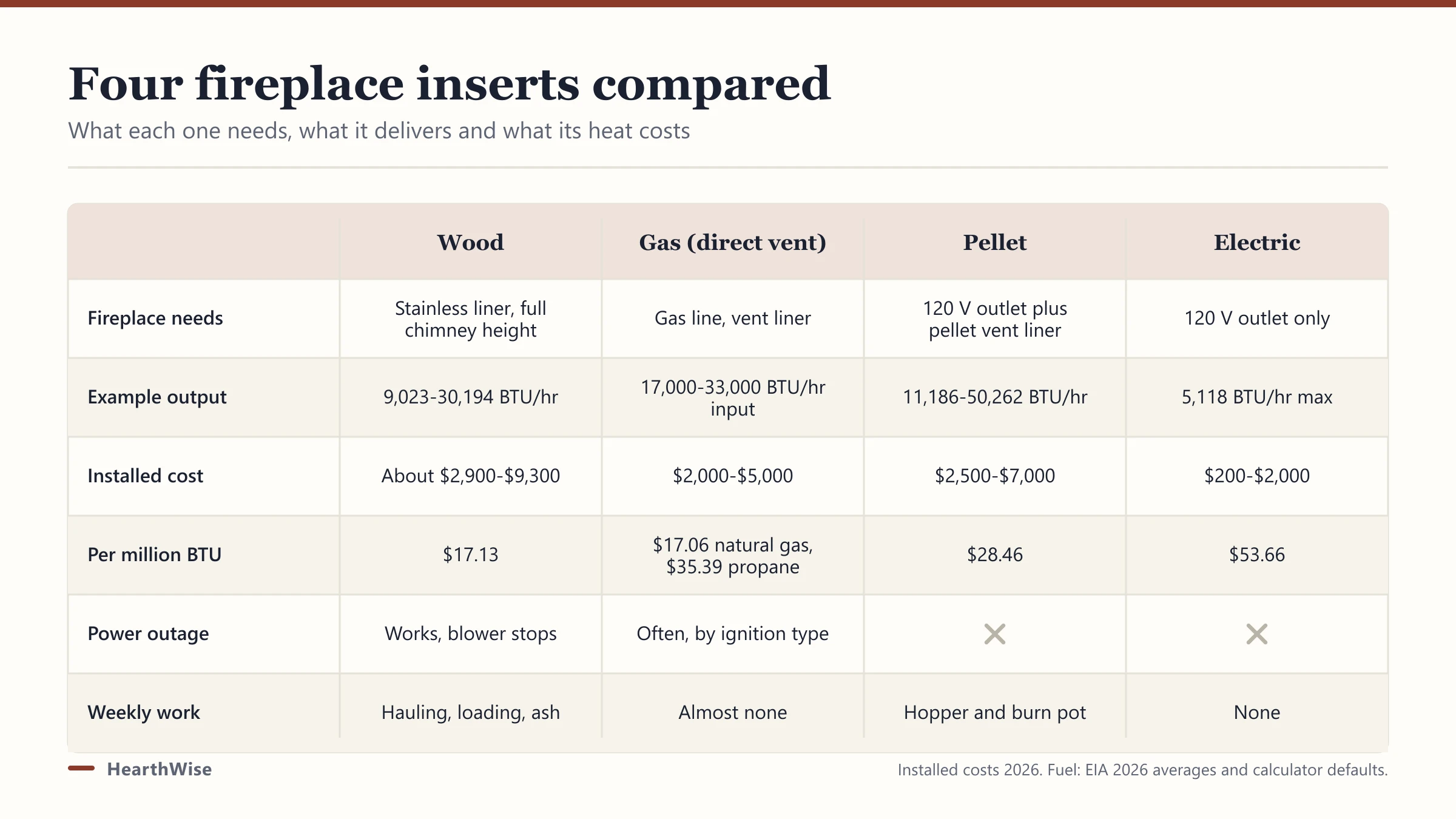
The four insert types differ most on what your house needs to support them and what each million BTU of heat costs.
| Wood | Gas (direct vent) | Pellet | Electric | |
|---|---|---|---|---|
| Your fireplace needs | Stainless liner, full chimney height | Gas line plus vent liner | 120 V outlet plus pellet vent liner | 120 V outlet only |
| Example heat output (BTU/hr) | 9,023-30,194 (Blaze King Princess insert, EPA) | 17,000-33,000 input (Lopi Radiant Plus Large, NG) | 11,186-50,262 (Harman Accentra52i-TC, EPA) | 5,118 max (1,500 W) |
| Efficiency used below | 75% | 79% (P.4.1) | 75% | 100% |
| Installed cost, 2026 | About $2,900-$9,300 (unit plus installed liner) | $2,000-$5,000 | $2,500-$7,000 | $200-$2,000 |
| Cost per million BTU delivered | $17.13 | $17.06 natural gas, $35.39 propane | $28.46 | $53.66 |
| Works in a power outage | Yes (blower stops) | Often, by ignition type | No, without backup | No |
| Weekly work | Hauling, loading, ash | Almost none | Filling hopper, burn pot | None |
Cost and fuel sources are in the sections below. The wood row combines a $1,400-$4,300 insert with a $1,500-$5,000 liner, because cost guides rarely price the two together.
How much does each insert cost to run?
At October 2026 prices, a wood insert and a natural gas insert deliver heat for about $17 per million BTU, pellets cost about $28, propane about $35, and electric resistance heat about $54. Electric is the most expensive way to make heat in an insert.
| Fuel | Price used | Efficiency | Delivered $ per million BTU |
|---|---|---|---|
| Cordwood (red oak) | $325 per cord | 75% | $17.13 |
| Natural gas | $1.35 per therm | 79% | $17.06 |
| Wood pellets | $350 per ton | 75% | $28.46 |
| Propane | $2.56 per gallon | 79% | $35.39 |
| Electricity | 18.31 cents per kWh | 100% | $53.66 |
Gas, propane and electricity are US residential averages from the EIA (natural gas January 2026, propane week of January 12, 2026, electricity July 2026). Cordwood and pellet prices are the defaults in our calculator, inside HomeGuide’s 2026 ranges of $275-$500 per cord and $300-$400 per ton. Your local prices can move any row a lot, so plug them into the wood stove size and fuel calculator, which builds the same table for your area.
What heat output can each insert type deliver?
Wood, gas and pellet inserts can each heat a large living area, while an electric insert cannot. EPA-tested ranges for wood and pellet inserts run from under 10,000 to about 50,000 BTU/hr depending on the model, and the Lopi Radiant Plus Large gas insert, for example, burns 17,000 to 33,000 BTU/hr of natural gas input.
Electric is the outlier. Plug-in electric inserts are capped at about 1,500 W so they can run on a standard 120 V household circuit, and 1,500 W equals 5,118 BTU/hr, which is space-heater territory. At 18.31 cents per kWh, running one flat out costs about 27 cents an hour. Size wood, gas and pellet inserts the same way as a stove, from your home’s design heat load; the wood stove buying guide explains why oversizing causes smoldering and creosote.
When is a wood-burning insert the right choice?
A wood-burning insert is the right choice when you have access to affordable seasoned firewood, want heat that works with the power off, and will tend a fire. It delivers the cheapest heat in the comparison at typical cordwood prices.
The cost is in the chimney. Wood insert manuals typically call for a stainless liner that runs the full height of the chimney, and HomeGuide puts an installed liner at $1,500 to $5,000 or more in 2026. Insert prices at brand stores ranged from $1,399.99 (US Stove 1800 insert) to $4,308 (Vermont Castings Montpelier II) in October 2026. Measuring the firebox, liner sizing and named wood inserts are in the wood-burning fireplace inserts guide.
When is a gas fireplace insert the right choice?
A gas insert is the right choice when a gas line is available or easy to run and you want heat at the push of a button with no fuel handling. HomeGuide prices a standard gas insert at $2,000 to $5,000 installed in 2026, with vented units at $2,500 to $3,500 before installation.
Direct-vent inserts draw combustion air from outside and exhaust through a sealed liner, so room air stays out of the fire. Vent-free (ventless) inserts are cheaper, at $700 to $2,500 for the unit, but exhaust into the room and are restricted in some states and cities, so check local code first. On natural gas, running cost matches wood; on propane it doubles. Gas line and venting work belongs to a licensed professional. The gas fireplace inserts guide compares direct vent and ventless in detail.
Is a pellet fireplace insert a good idea?
A pellet insert is a good idea if you want thermostat-controlled heat from an existing fireplace with no gas line and no log hauling, and you can store pellets by the ton. HomeGuide puts pellet inserts at $2,500 to $7,000 installed in 2026.
| Pellet insert | Brand-store price (Oct 2026) | EPA output (BTU/hr) | EPA efficiency |
|---|---|---|---|
| Harman Accentra52i-TC | $6,049 | 11,186-50,262 | 76% |
| Quadra-Fire Trekker insert | $5,558 | 12,682-39,428 | 78% |
| Harman P42i-TC | $5,229 | 5,637-32,782 | 79% |
| Quadra-Fire Classic Bay 1200 insert | $4,538 | 10,182-33,925 | 64% |
Inserts have smaller hoppers than freestanding stoves; the Accentra52i-TC holds 64.5 lb, about a bag and a half. They need a 120 V outlet and stop in a power outage without backup. How pellet appliances work is covered in the pellet stove guide, and freestanding models in the best pellet stoves roundup.
When is an electric fireplace insert enough?
An electric insert is enough when you want the look of a fire and a little supplemental warmth, not real heating. It plugs into a 120 V outlet, needs no chimney, and HomeGuide prices electric fireplace inserts at $200 to $2,000.
That makes electric the right answer for renters, for a fireplace with a damaged chimney you do not want to reline, and for rooms where you mostly want ambiance. It is the wrong answer for heating a house: 5,118 BTU/hr is the ceiling, and at average US electricity prices it is the most expensive heat in this comparison. The electric fireplace inserts guide covers flame technology, sizing to the opening and cost per hour.
What does your fireplace need before any insert goes in?
Before choosing a fuel, have the chimney and fireplace inspected by a certified chimney sweep (CSIA). The inspection tells you whether the masonry and smoke chamber are sound, what size liner fits, and whether the fireplace is masonry or factory-built.
Then match the insert to the fireplace. The firebox opening must fit the insert’s minimum dimensions from its manual. A factory-built fireplace accepts only an insert listed for it. Liner type and size, clearances and hearth extension requirements come from the insert’s installation manual, NFPA 211 and local code, and the EPA notes that a certified installer should make sure the liner is installed correctly. HearthWise does not give installation steps; budget for a permit and a certified installer.
Which fireplace insert should you choose?
Pick the insert by your fuel access, how much you heat and how often the power fails, not by the flame picture in the showroom. Running cost and outage behavior separate the four types more than looks do, and the right answer for a rural home with a woodlot is rarely the right answer for a city condo.
| Your situation | Best fit |
|---|---|
| Cheap or free firewood, frequent outages | Wood insert |
| Natural gas at the house, want zero fuel handling | Direct-vent gas insert |
| No gas line, want thermostat heat, can store pellets | Pellet insert |
| Propane only, heating many hours a day | Wood or pellet (propane costs about twice as much per BTU) |
| Renting, decorative use, or chimney unusable | Electric insert |
| Heating a whole small home from the fireplace | Wood or pellet, sized with the calculator |
Who should not install a fireplace insert?
An insert is not worth it for everyone. If you light the fireplace a few evenings a year for atmosphere, a liner and a $3,000 to $9,000 heater will never pay back; tight-fitting glass doors or an electric unit cost far less. If the chimney is badly damaged, get the repair estimate first, because rebuilding the chimney can cost more than the insert.
And if your home needs heat in a room with no fireplace at all, a freestanding stove placed where the heat is needed usually serves better than an insert in the wrong room. Start with the wood stove buying guide or the pellet stove guide.
Sources: EPA Burn Wise: choosing wood-burning appliances, EPA Burn Wise: energy efficiency, EPA Certified Wood Heater Database, HomeGuide gas fireplace insert cost, HomeGuide pellet stove installation cost, HomeGuide electric fireplace cost, HomeGuide wood stove installation cost, EIA residential natural gas price, EIA residential propane price, EIA electricity price by state, Table 5.6.A, Lopi Radiant Plus Large GSB insert, Forge & Flame inserts, US Stove wood stoves and inserts.
Frequently asked questions
Quick answers to what readers ask us most
Which type of fireplace insert is best?
For the lowest running cost and heat in a power outage, wood. For convenience where natural gas is piped in, gas. For automatic heat without a gas line, pellet. Electric only suits decoration and a small room, since it tops out at 5,118 BTU/hr.
How much does a fireplace insert cost installed?
In 2026, HomeGuide puts gas inserts at $2,000 to $5,000 installed and pellet inserts at $2,500 to $7,000. A wood insert runs about $1,400 to $4,300 for the unit plus $1,500 to $5,000 for the liner. Electric inserts cost $200 to $2,000.
Do fireplace inserts need a chimney liner?
Wood, pellet and vented gas inserts vent through a liner run up the existing chimney, sized and specified by the insert's installation manual. Electric inserts need no venting at all, only a 120 V outlet.
Can I put an insert in a prefab fireplace?
Only an insert that was designed and tested for that factory-built (zero-clearance) fireplace, the EPA says. Check the fireplace's listing label and the insert's manual, and have a certified installer confirm the match.
Which fireplace insert works during a power outage?
A wood insert keeps heating with no power, though its blower stops. Many gas inserts can run on a battery backup or standing pilot, depending on the ignition system. Pellet and electric inserts stop without backup power.