
Pellet Stoves: How They Work, Costs, and Who They Suit
How a pellet stove works, what it needs in your house, what it costs to buy, install and run in 2026, how long a hopper lasts, and who should skip one.
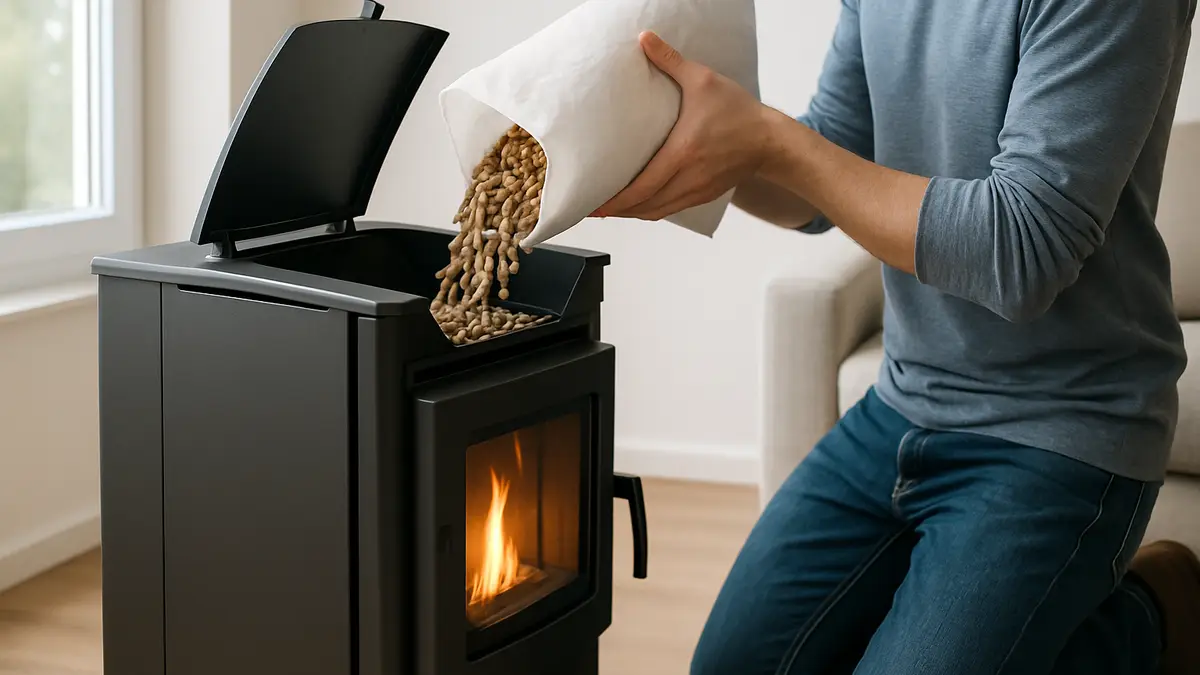
A pellet stove is a room heater that burns compressed wood pellets automatically: you fill a hopper, set a heat level or thermostat, and the stove feeds itself for a day or more. It sits between a wood stove and a furnace, with wood-based fuel but thermostat-style control. This guide explains how it works, what it needs, what it costs and who it fits. For named models with EPA test data, see the best pellet stoves of 2026.
How does a pellet stove work?
A pellet stove meters fuel with an electric auger. Pellets drop from the hopper onto a rotating screw that delivers them to a small burn pot, where an electric igniter lights them. A combustion fan pulls in air for the fire and pushes exhaust out the vent pipe, and a separate room blower moves air across a heat exchanger and into the room.
A control board ties it together. It sets the feed rate for each heat level, and on thermostat models it raises or lowers the fire to hold a room temperature. Safety switches watch the hopper lid, the exhaust draft and the stove temperature, and shut the feed off when something is wrong. Because the stove burns a small, steady amount of uniform fuel, pellet stoves test clean: the median pellet stove in the EPA database emits 1.1 g/hr, against 1.7 g/hr for the median non-catalytic wood stove.
What does a pellet stove need in your house?
A pellet stove needs three things: a standard 120 V outlet, a vent to the outside, and a floor and wall arrangement that meets its manual.
- Power. The auger, fans and igniter run on household current. HomeGuide puts the electricity at $10 to $20 a month in heating season.
- Venting. Most pellet stoves vent through an outside wall with 3 or 4 inch pellet vent pipe; no masonry chimney is needed. The Wiseway GW1949, for example, uses 3 inch pellet vent that can connect into a 4 or 6 inch chimney.
- Hearth and clearances. Floor protection and clearances to walls and furniture come from the stove’s listing label and manual.
Some models are approved for manufactured homes with an outside air kit; PelPro says its PP70 is mobile home approved with the included fresh air kit. Venting, clearances and the outlet circuit are work for the manual, local code and a certified installer, not a weekend project.
How long does a hopper of pellets last?
A full hopper lasts anywhere from about 8 hours on high to several days on low, depending on hopper size and burn rate. Pellets carry about 8,200 BTU per pound (16.4 million BTU per ton, the EIA calculator value), so burn time is the hopper’s pounds times 8,200 times efficiency, divided by the heat output.
| Stove | Hopper (lb) | Hours at EPA low output | Hours at EPA high output |
|---|---|---|---|
| PelPro PP130 | 130 | about 91 | about 21 |
| PelPro PP70 | 70 | about 50 | about 13 |
| Quadra-Fire Trekker | 80 | about 40 | about 13 |
| Wiseway GW1949 (non-electric) | 60 | about 27 | about 13 |
| Harman P43 | 50 | about 17 | about 9 |
Our calculation from maker hopper sizes and EPA-tested output and efficiency, October 2026. Real times run shorter with dense pellets packing more weight in, or longer with light ones, and when the thermostat cycles the stove down.
How much does a pellet stove cost to buy and install?
A freestanding pellet stove costs $900 to $2,600 for the unit and $1,600 to $4,100 installed, according to HomeGuide’s 2026 figures, with installation labor at $700 to $1,500.
| Type | Unit price | Installed |
|---|---|---|
| Freestanding | $900-$2,600 | $1,600-$4,100 |
| Wall-mounted | $1,500-$2,500 | $2,200-$3,800 |
| Fireplace insert | $1,500-$4,500 | $2,500-$7,000 |
Brand-store list prices in October 2026 show the spread: the non-electric Wiseway GW1949 at $1,149.99, the PelPro PP70 at $1,619, and the Harman P61 at $5,179. Dealer-sold brands such as Harman and Quadra-Fire cost more and come with local service; big-box brands cost less and leave more of the upkeep to you. The pellet stove installation cost breakdown prices the vent, floor protection, outlet and labor line by line.
Is the federal tax credit for pellet stoves still available?
No. The 30% federal credit for biomass stoves, up to $2,000 a year for stoves rated at least 75% efficient (HHV), covered only property placed in service through December 31, 2025, per the IRS. Some cost guides still say it runs through 2032; that is out of date. Check your state energy office and utility for any local rebates instead.
What does it cost to heat with pellets compared with other fuels?
At $350 a ton and 75% efficiency, pellet heat costs about $28.46 per million BTU delivered. That beats propane, heating oil and electric resistance heat at 2026 US average prices, but loses to natural gas, heat pumps and cordwood.
| Fuel and appliance | Price used | $ per million BTU delivered |
|---|---|---|
| Natural gas furnace, 85% | $1.35/therm (EIA, Jan 2026) | $15.85 |
| Cordwood stove, 70% | $325/cord red oak | $18.35 |
| Heat pump, seasonal COP 2.5 | 18.31 cents/kWh (EIA, Jul 2026) | $21.47 |
| Pellet stove, 75% | $350/ton | $28.46 |
| Heating oil furnace, 83% | $3.62/gal (EIA, Jan 12, 2026) | $31.53 |
| Propane furnace, 85% | $2.56/gal (EIA, Jan 12, 2026) | $32.89 |
| Electric baseboard, 100% | 18.31 cents/kWh | $53.66 |
Pellet and cordwood prices are our calculator’s defaults, inside HomeGuide’s ranges ($300-$400 a ton, $275-$500 a cord). The full head-to-head with a wood stove, including labor and storage, is in pellet stove vs wood stove.
How many tons of pellets will you burn in a winter?
Most people burn 2 to 3 tons of pellets a year, according to HomeGuide, a figure that fits a stove heating part of a house rather than all of it. A 1,000 sq ft tight home in a Baltimore-like climate, with the stove covering half the heat, needs about 1.1 tons, or 57 bags of 40 lb.
Heating a whole house is a different scale. An average-insulated 2,000 sq ft home in a Chicago-like climate needs about 106 million BTU of delivered heat a season, which is about 8.6 tons of pellets at 75% efficiency, or 430 bags. Run your own numbers in the wood stove size and fuel calculator by choosing pellets as the fuel, and read the wood pellets guide for grades, ash content and storage.
How much maintenance does a pellet stove need?
A pellet stove needs more routine cleaning than a wood stove, but in small doses. US Stove tells owners to empty and clean the burn pot before each ignition and to inspect it daily when the stove runs continuously, because ash and clinkers in the pot choke the airflow.
Expect to empty the ash pan and wipe the glass regularly, depending on how much you burn and how much ash your pellets leave. Once a year, before the season, have the stove and its vent pipe cleaned and checked: fans, gaskets, the auger and the exhaust path. Low-ash premium pellets stretch every interval, which is why fuel choice matters as much as the stove. If the stove will not light, shuts itself down or burns with a lazy flame, our pellet stove problems guide works through the causes by symptom.
Can a pellet stove run during a power outage?
Most pellet stoves cannot run without electricity. The EPA notes that, unlike wood stoves, most pellet stoves need power to operate, and when the auger and fans stop, the fire goes out.
There are two workarounds. A backup power source keeps a standard stove running; US Stove recommends at least a 1,000 W pure sine wave inverter battery backup for short outages, or a 1,000 W inverter generator. The other route is a gravity-fed, non-electric pellet stove. The Wiseway GW1949 ($1,149.99 at US Stove, October 2026) feeds pellets by gravity from a 60 lb hopper with no auger or fans, and US Stove lists up to 30 hours on its lowest setting. With no blower, it heats by radiation and natural convection only, and you set the burn rate by hand with a damper rather than a thermostat.
Should you buy a freestanding pellet stove or a pellet insert?
Buy a freestanding pellet stove if you are placing heat in a room without a fireplace or want the largest hopper and output for the money. Buy a pellet insert if you have an open fireplace you want to turn into a heater; it vents up a liner in the existing chimney.
Inserts cost more installed ($2,500 to $7,000 by HomeGuide’s 2026 range) and carry smaller hoppers: the Harman Accentra52i-TC holds 64.5 lb against 130 lb in a freestanding PelPro PP130. If you are weighing a pellet insert against wood, gas and electric options, the fireplace inserts guide compares all four.
How do you read pellet stove output and efficiency claims?
Compare pellet stoves on the EPA database’s tested output range and HHV efficiency, because maker headline numbers are measured differently. Harman’s “heat output” figures are BTU input, which Harman defines as the maximum feed rate times about 8,600 BTU per pound. The Harman P43 is listed at 45,200 BTU/hr on that basis; its EPA-tested output tops out at 33,252.
Efficiency headlines often use the lower heating value. PelPro advertises 88.5% for the PP70 and 87.5% for the PP130; the EPA database lists the same stoves at 83% and 82% HHV. Neither number is false, but only the HHV figure lines up across brands. The median of all 108 pellet stove rows in the EPA database is 77% HHV.
Who is a pellet stove right for?
A pellet stove suits people who want wood-based heat without the woodpile. It fits best if you:
- Want thermostat or dial control and a fire that tends itself for a day or more.
- Have dry indoor or garage space for 1 to 3 tons of bagged pellets (50 bags per ton).
- Pay for propane, heating oil or electric resistance heat, all of which cost more per BTU.
- Have no chimney, since a wall vent is usually enough.
Who should not buy a pellet stove?
Skip a pellet stove if your power goes out often and you will not buy a backup source or a non-electric model; a wood stove heats with no power at all. Skip it if you have natural gas, which delivers heat for about 45% less per BTU at 2026 average prices. And skip it if you dislike fan and auger noise or cannot store pellets dry, since damp pellets swell and crumble.
If you have free or cheap firewood and the time to split and season it, cordwood costs about a third less per BTU than pellets at the prices above.
Sources: EPA Certified Wood Heater Database, EPA Burn Wise: choosing wood-burning appliances, HomeGuide pellet stove installation cost, IRS Energy Efficient Home Improvement Credit, US Stove Wiseway GW1949, US Stove US5522-W FAQ, Forge & Flame Harman P43, Forge & Flame PelPro PP70, Forge & Flame PelPro PP130, EIA residential natural gas price, EIA residential propane price, EIA residential heating oil price, EIA electricity prices, Table 5.6.A.
Frequently asked questions
Quick answers to what readers ask us most
How does a pellet stove work?
An electric auger moves pellets from a hopper into a burn pot, an igniter lights them, a combustion fan feeds air and pushes exhaust out the vent, and a room blower sends heat through a heat exchanger into the house. A control board or thermostat sets the feed rate.
How much does it cost to run a pellet stove?
At $350 a ton and 75% efficiency, pellet heat costs about $28 per million BTU delivered. HomeGuide puts total running cost at $130 to $220 a month in heating season for pellets and electricity, with electricity alone at $10 to $20.
Do pellet stoves work without electricity?
Most do not. The auger, fans and igniter all need power, so heat stops in an outage. US Stove recommends at least a 1,000 W pure sine wave inverter backup or a 1,000 W inverter generator. A few gravity-fed models, such as the Wiseway GW1949, need no power.
How long does a bag of pellets last in a pellet stove?
A 40 lb bag holds about 328,000 BTU. A stove delivering 20,000 BTU/hr at 78% efficiency burns through it in about 13 hours; on a low setting it can last a day or more, and on high, about 6 to 8 hours.
Do pellet stoves need a chimney?
No masonry chimney is required. Most pellet stoves vent through an outside wall with 3 or 4 inch pellet vent pipe, with the diameter, run length and termination clearances set by the stove's installation manual and local code.